5.14.2008

You're not as qualified as you think you are

I got a call yesterday from a very attractive company that they made an offer to another candidate. Here's the feedback, paraphrased and condensed.
  • We need someone who can hit the ground running. The candidate we selected had more years hands-on experience doing ... [insert two common training design, project management tasks]
  • We think that your skills are best suited to a role called [job title]. I had asked what skills I should practice to be better suited to the job that I'd not won; that answer was, start lower and show us what you've got.
  • We can't recommend a better way to establish a relationship with this company when it comes to hiring for that role; keep an eye on the web site. I had asked, what's the best way to uncover new opportunities when there are job openings by that name.
To give the company its due, this is more complete and concrete feedback than I've received from any of those I've interviewed with. The sting of not being chosen was softened by the knowledge, implied in the discussion above, that interviewers force ranked candidates' capabilities.

Even if I had been nominally qualified, I lost the horse race at a time when a lot of strong horses are in the recession - oh, did I say "recession?" - I meant "race." And the candidate horse race is the black box of the interview process. It's fast moving, difficult to learn about, and difficult to influence.

Lessons

"God grant me the serenity to accept the things I cannot change..."
  • Job experience is limiting. Even CEOs must accept this truism.
  • Big companies approach many decisions as an opportunity to mitigate risk, making hiring an exercise in seeking the sure thing. Experience proves, they're right to do so.
"...the courage to change the things I can..."
  • Determine whether the message of the stories of your experience fits your job search goals (individual contributor, creative force, expert practitioner, strategic and forward thinker?)
  • Review and refine the stories of your accomplishments.
  • Identify, and learn enough to speak confidently about, the expertise you anticipate needing for particular roles. If you can't be experienced, you can master the knowledge.
  • Pick some area of weakness and invest in your own development.
"...and the wisdom to know the difference."
  • It's human nature to lean toward those things we want, and when they're pulled out from under us, that pratfall stings.
  • Jobs are best seen as serving instrumental goals - learning, acquiring broader scope of responsibility, linking one's actions to business results, doing incremental good.
  • Jobs are best not seen as serving fundamental goals - making one happy, saving the world, providing social support.

5.03.2008

Two interviews

Nothing takes the place of interviewing with hiring managers. All the practice pays off. And the sharp and flat notes seem very loud.

In April, I interviewed with a financial services company. What did I learn? Two things:

Ask for clarification about what the interviewer is asking.

Seems so simple. You think you understand the question you're answering, and if you're like me you select the anecdote that makes your germane experience and skills concrete. But if you're off the mark a bit, or if the question only hints at the real issue, you'll spend minutes guessing why you're not connecting.

If you were like me in this interview, you'd reframe the story in the middle of the telling. Your story starts to sound abstract, the flop sweat trickles in the small of your back, and you realize he's not so sure about your sense of judgment anymore, "Does this guy get it?" you think you smell him thinking.

In another recent interview, I asked for clarification about the heart of the issue. Because in the first situation above, I suspect that the question had to do with organizatonal pain that senior manager was suffering that week (or that quarter, granting the benefit of the doubt). I don't think that I was required to have experience doing exactly what she believed she needed. But I missed the opportunity to describe how I could focus on the heart of the issue. Here's what I mean.
The question. "Tell me about a time when you have successfully negotiated with clients."
Connotation is everything. "Negotiation" connotes irreconcilable differences resolved through zero-sum gamesmanship: banging shoes on desks, non-stop meetings, and theatrical psychodrama that ends with reluctant compromise whose success is measured in terms of who was bruised more and gave up the most. I don't do that. I fire clients who do that.

But, too belatedly, I realized that throughout every learning project, I negotiate dozens of compromises over scope, budget, method, schedule - even whether or not to use role plays. The guideline, and the process, runs this way:
  • Aim high
  • Argue cogently
  • Listen and accept new information; seek out new approaches
  • Take real limitations seriously
  • Find an effective method to create engaging learning that accounts for all of those factors.
That's negotiation if you like, but I call it good project management with a dose of brainstorming and imagination. Little drama; lots of collaboration.

Coaching: Addressing Unclear Questions

There are a number of good follow-up questions I could have asked.

Clarifying:
  • I'd like to speak to that, but what do clients commonly feel a need to negotiate about?
  • Happy to answer. Could you give me a recent example of the kind of situation you're thinking of so that I can understand the issue better?
Demonstrating understanding and insight
  • When I think of negotiating, I think of situations in which the two sides have hardened positions aren't willing to change, or only very reluctantly? How well does that describe the kind of negotiating you're thinking of?
  • Help me understand the situation better. What's at risk if the person doesn't negiatate well?

3.26.2008

Working on it

When a man doesn't have enough to do, he does what he can.

Not the thing he always dreamed of. Or the things that would save a little money, like sealing windows. Not the things that the world needs, like helping at an after school program or working for Hil-bama.

He spends as much time as he can learning the things that working left too little time for. He reads about things he's interested in, wondering if there's a career change to be made. Excitement follows. He talks about, let's say, a job in information architecture. He learns more about it and concludes it's nothing like what he imagined.

And the career he had - has - looks pretty good again. Everything considered. Did you know that Monster.com will deliver job listing directly to your - his - email box? He applies. He's doing what he can.

He cooks and cleans and does laundry, because if he's not working hard he can hold up his end of home life. And he's not complaining. He likes to cook.

He also writes comments on blogs, reads a few dozen feeds, checks out source material for ideas mentioned in passing on other's websites. Some seem worth knowing about. He buys a book to check them out. Some of those idea seem like something to talk about rather than something to know about deeply. The kind of topic that someone, who has already become the expert, has also already exhausted.

He cannot stay cheery every day, but he tries not to mope.

the tour continues

I've revived the Tour to track the very personal ups and downs of job hunting and exploring what I learn. Here, all bets are off, including the sunny optimism that bloggers who want an audience wisely adopt. The Tour is a job hunter in a down economy talking to the camera in a closet on a reality show. Or with buddies over a beer.

I went to a meeting recently to learn about Web 2.0 in the enterprise environment. It seemed to me that a lot of very smart people were thrashing around and not answering the question, "How will we know when "collaboration tools" (read Web 2.0) will be worth it?" There were a lot of worriers wringing their hands about privacy and security. And a lot of others saying that the tools don't do what they need them to do: sort, extract data, offer search, integrate with other tools. The implied answer to the question is "What's the minimum set of conditions that collaboration must meet to make it worth time and money to try it out?" A list of things, some opportunities and some risks. When you get close to that spec, you evaluate again.

What's everyone so worried about?

I suppose it's a fear of getting bitten by technology choices. The case study company that presented at the meeting is building social networking tools behind their corporate moat to address security and privacy concerns. But that means as their tech. vendors grow, change, and are bought, there's no telling how well the products will serve their customer. A few dizzy dot com years ago, a web team I was on made a purchase decision only to find the company was out of business before they could install the software. We consumers, working in the public space, don't have to worry about that. We decide we don't like del.icio.us anymore, we move on. But for organization men, it's a fair worry.

I suppose the second worry, though less discussed, is that some of the most useful people in the corporate social network may be the least productive. They're busy blogging, referring, pointing to resources, and fostering a discussion. Which in fact, is productive, unless it's not measured. If no one measures the value of "connector" roles, then those folks are just farting around on the internet.

12.06.2005

All I want for Xmax (sic)

For those who love me and\ feel obliged to do the President's evil bidding by buying gifts this holiday season, consider these:

USB Infrared link (to communicate between my phone and computer) $40. This is one of those, don't really need but would totally love gifts.

Charcoal starter chimney for grill (range of prices; Weber offers a highly engineered, expensive one. Simple and inexpensive is perfectly fine with me).

Ski gloves (Probably best to give these in the form of a gift certificate to REI. I don't know what I want.)

Books, music, movies found here.

The future is digital, so gift certificates from this hateful store. Think in modest denominations.

Ask yourself: WWJD? What would John do?

12.04.2005

With Feeling

For everything John-, John-and-movie-, and John-and-screenwriting-related, go to Darkness Visible. As the museum audio guides say, "I'll meet you there."

11.28.2005

Flyover: The Left Coast trip

Screenwriting Expo: Whoa, dude!

A week in Santa Monica: Excellent!

Thanksgiving in Cornville, AZ: You can't choose your family. You convince yourself that you can choose the person you love. But you can't choose her family either. Nevertheless, the turkey was mah-velous.

Folks, it seems a little crazy to keep two blogs. Henceforth, go to Darkness Visible for everything writing and John-the-Edutainer related.

11.10.2005

L.A.g

...jet-wise. A couple quick notes after touchdown.

The most important thing to report is that Internet access is limited until I sniff around and find a jumping on point.

Last night made a breathtaking night to arrive. The moon shone onto a scrim of clouds. Searchlights played against them from below. The city spread out like big flat city. Why does it look so good on film? Michael Mann, David Lynch, how’d you do that?

By the time I reached my downtown hotel, I found myself asking questions about people on foot, who look odder than two people sighted beside cars engaged in conversation on the shoulder of the 110 freeway. “I wonder what’s wrong with that guy’s car?” You never know where that kind of reverie will lead!

11.08.2005

Meet with Next Generation of Screenwriting Heavyweights

Aren't we? Until further notice, you're damned right we are.

It's official. The Scribosphere (blogging screenwriters) will gather at the Veranda bar at the Figueroa Hotel on Sunday night, November 13th and dare to look at each other's god-given faces in three dimensions.

The idea for a live, in-person meeting of screenwriters from the blogosphere to coincide with the Screenwriting Expo started at Dave's site, and quickly took flight thanks to L.A. local men Warren and Fun Joel. Illustrations and other particulars can be found at Warren and Joel's sites.

Warren promises to buy drinks if he wins the Creative Screenwriting Open scene competition. The gauntlet is down. Single-malts at dusk!

11.02.2005

L.A.nticipation

I'm a big believer in working and hoping. Working hard (and selling cleverly) and hoping to be the person who gets the surprising break. So I'm writing screenplays. One drama done. One comedy in the early outline stage. So far it's like trying to learn the craft as if it had never been practiced before.

Next week I go to Screenwriters' Expo to mingle with hundreds of other strivers, hope-junkies, delusional types, and some real, skilled - hell, employed - writers. Could change my life. More likely, I'll meet some good company and learn stuff. That's great. And California, I'll be making a small contribution - but only by some measures - to your economy. Throw me a bone, will ya?

My Wildest Dreams: to return from L.A. with a mentor in the person of a known, working writer. Realistic goal: meet a bunch of people more advanced than me who are willing to use the web to keep on meeting and teaching each other through good criticism.

As in an earlier year, Jay Leno and the Tonight Show will tape story pitches by Expo participants (It's "Toy Story" meets "Romeo is Dying"). Word is, the studio audience votes on whether the story is sold or not. And then the sale/no sale is revealed. I'll keep you informed about where and when to see this segment, but do not - I repeat - do not look for this guy on-camera.

In the meantime, it's great to be home. The Woman I Love (TWIL) is even happier than me. Does it have to do with my compulsive tidiness, my cooking skills, my svelte form? Doubtful. She unaccountably likes me; it's the core of her considerable charm.

[Swiped the photo from a Hollywood fan. Click on the title to go to the source. Apologies/thanks.]

10.30.2005

Case Closed

What's that? The state capital building, an erection of Huey Long, as I understandt it. Farewell Baton Rouge!

What's the verdict? Well, it's the wrong question. The question is whether you have any regrets, whether you wasted your time, whether you worked hard and well but accomplished nothing. No. To all three. I paid with frustration and missed opportunities by being away from The Woman I Love (TWIL) for the greatest part of the last ten months. I have come to dismay over miserable cellphone service that interrupts us twice each evening. I have come to appreciate how greatthe effect of her love and respect is. And I'm grateful for her patience. I've also recalled how much I enjoy an evening to myself, a Saturday without plans, a day filled with movies.

I rewrote a movie script of my own creation, I shot part of a DV movie that may yet acquire a story to go with that footage, I gave what advice I had to the trainer I worked with most closely, I played well with others. And I'm exhausted with the effort of leaving.

I suffer leaving as if it were a physical wound. That's why I did not visit home more often. TWIL was always glad to have me visit, for however short a time. But between the fatigue of arriving (six hours aloft) and the distress of leaving, it offered me real frustration in the 40 hours I was home. I know what you're thinking. I mean psychic frustration.

Even leaving Louisiana was not easy. People were warm and I was appreciated. I will miss is the daily sense of direction and progress that work offers, the pleasure of reliable human contact on a wider scope than home, and the opportunity to influence people.

I will not miss C.M. (See a previous post.) Finally, at the urging of the project leader, I talked with C.M. about our disagreements. We made a lot of progress, but I'd be a simpleton to think it changed her, or me. It comes down to this, in my biased interpretation: C.M. wielded the authority of her office to engineer the perception of success in everything she does. The effect is poor, but the story it allows her to tell is a good one.

10.23.2005

Like a camel through the eye of a needle, so are the days of our lives

What's a training pilot look like? Or first, what is it? You take the course materials you've been creating and improving and you teach them to the audience they're intended for.

What it looks like is three weeks of standing in a windowless room for eight hours a day, fielding questions that you may or may not know the answer to. It nearly always requires four to six hours of preparation between 6:00 p.m. and 7:00 a.m. I'm not complaining, just reporting. As to what happens, you aim to hit the target: participants grow confident using new skills and generally have a good feeling about the experience. You want to know how close to center of the target you struck. The first requires learning objectives (for you training types out there). The second requires evaluation.

In practice, the success of a pilot depends to some extent on the facilitator. When materials aren't quite right, the pace is slow, the activity crashes and burns, you want someone in front of the room who can pull a rabbit out of his or her ... hat. Our pilot went well. We saw our share of rabbits. Most lived through the experience of being yanked by the ears.

I mentioned internal political ructions in my last post. They continued, but aren't worth mentioning now. On that note, a truism: everyone chooses to involve themselves with co-workers based on a set of pre-requisites: commitment (how much do I respect this person), pragmatism (how will this help or hurt a relationship that may be tested in similar ways in the future), and neurosis (You can't push me around, I'm afraid of conflict, She got this attitude, etc. Insert yours here.). Here's my litmus-test question before giving feedback: Are we going to work together again and do I want it to work better next time? And that's all I need to say about that.

With one week left to go before my Rapture-by-jetliner, one thing I feel strongly as I look back over ten months is that people have been individually very warm to me. I'm grateful. Working with the same people all the time provides a lot of social support, even when it leads to conflict. And once you've earned a little respect, you begin to have the power of influence. Always less than you'd hope. But it's real. I have an undying hope to do good, make people better for having had to do with me. It's a little crazy (See above, re: neurosis). I'm very grateful for genuine kindness I've been offered here. I hope that my influence and the genuine kindness I returned totes up in the "good effect" column.

9.27.2005

The End is Near

The end, that is, of two things. My stint in Louisiana, which ends October 29. I began working here last December (2004) on a four-month contract. Project problems - or challenges or opportunities - postponed the first big deadline twice. I agreed to stay on. But I made it clear that after Halloween I had other commitments that I could not change.

That first big deadline is changing again. Rumors have one or two months from the most recently agreed upon date. The rationale lies entirely on the technical side: getting software to address business issues as desired, anticipated, and needed. Training can always be ready, almost whenever the starting gun fires. And training can always be made better. We serve at the pleasure of the business.

Also at an end is the preparation for training. We have materials, policies, a training system (a model of the working system), and we nearly have an instructional design. We could use a lot more examples and exercises. We're training experienced employees. In other classes for other business units, they're learning quickly. They're getting it. This is likely to mean that we start training well before participants will begin to use new skills, and that we'll wrap up early.

Today, the plan is to deliver the four weeks of training, wait three to eight weeks, provide a largely unstructured refresher, and drop people into the hot water of the new job. I think it's irresponsible. I'm going to argue that the training design must be changed to keep participants learning from any given starting point until production begins. The horse-pill of new policies can be swallowed, but only if live ammo drill and practice follow the hothouse practice in the classroom. And I bet I'll lose the argument. But as I said weeks ago, you hope to show clients new ways of doing things and enable them to succeed. You try to tell them the truth.

Finally, my consultant manager has been virtually AWOL. Let's call her the C.M. You try to tell the truth. We'll see where that gets me.

9.26.2005

Low and dry

I fled Baton Rouge on Friday in spite of having planned to stay the weekend. That is, a few days ago I was unwilling to spring an extra $600 to change my ticket from Boston to NYC, where my girlfriend has been working for the past four days. But as the women I work with tracked Rita, it moved North, slowed down, got stronger, and generally looked like the source of a week of electric-free living. That means food gets scarce, except for what you grill, which is in too great a supply - where do you keep it when the fire goes out? And a cheaper ticket popped up on my travel site. So I took off.

New York had perfect weather for walking the city. We did. Between fits of TV watching and web surfing to find out whether the South central US would shut down again for a few days. I'm glad that so few people were hurt during Rita and that it didn't hit property harder. But I'd have been very glad for a couple of days working from a NY hotel room. Besides the kind of typical incompetence one expects from airlines, the return at o'dark thirty Sunday morning was uneventful.

Baton Rouge gasped with traffic. And like Katrina, God's own leaf bag was shaken out everywhere. Here and there a downed tree. From those who stayed, the report comes that power was on and off for a twelve-hour period. The freezer stayed cold. Humidity soared yesterday afternoon, or maybe that's just the contrast to the Northeast. By five it felt normal again.

This week I relocate my cubicle to the building about six miles down the highway where the training rooms and staff are located. One week until the start of classroom training.

9.22.2005

I gotta go

Rita's coming and I'm going. More when I get to a really safe place.

(Thank noaa.gov for the photo.)

9.17.2005

Volunteer Training


The Federal Emergency Management Agency (FEMA) set up a Find Family national call center and asked for volunteers to help staff the phones. On Tuesday night I went for a one-hour training session that consisted of how to fill out forms for callers reporting people missing or known to be dead.

We learned not to give moral advice ("You have to be strong for your family.") or religious sentiment ("It's God's will that...."). We learned to try to offer compassion or at least sympathy ("I can't imagine how hard this must be." "I'm here. I'll stay on the line as long as we need to.")

I say we haven't been answering phones. Call volumes are low, and today it appears that calls weren't rolling to available phones down the banquet tables set up in a hotel ballroom near here. But on Thursday night I sat across from a woman who evacuated from Jefferson parish. She's staying with family. Her son's house in the capitol city is full. There are six families sleeping on air mattresses in every room of the house, so she went to a cousin's house instead. She can't find an apartment, her job has disappeared, and she cannot find out whether she can return to collect her stuff.

She'd consider moving, she said, but she'd need a job, which would cost her all of the years of service here, with all it's implications for pension and retirement. She told me she felt fortunate to have gotten food stamps, though she showed up at 4:00 a.m. to get in a line that was already long. The doors opened at 6:00 a.m. and she walked out the exit at 11:30 a.m. And she was pretty cheery as she waited for calls from other evacuees, getting paid a temp's $8.00/hour thanks to FEMA. "At least it's something," she said.

Last night, the local station broadcast a message that many shelters have a full supply of evacuees needs and that cash contributions should be made to the Red Cross instead. Now's the time to start thinking about concrete help beyond keeping body and soul together: jobs, housing, skill training, child care, and the list goes on.

Think hard about where to contribute again. The government is not going to take care of everyone. Given what we've seen lately, it makes sense for communities, businesses, and service agencies to collaborate to help give people new lives with possibilities, not just a trailer and a handout.

(Photo: Another beauty by an unknown photography from, I presume, Sunday, August 28.)

9.15.2005

Twister


Here is the first of a series of photos that were taken by, well, I don't really know. One of the women I'm working with was so excited that I'd stayed through Katrina, she immediately wanted to share these. "I keep telling my kids, this is history." But what about the damage? As Frou Frou sings, "...there's beauty in breakdown...."

9.11.2005

And we're back


Returned to Baton Rouge today through Houston, where I saw or heard:

"Expect to be there six months. That's what they told me." Overheard; a ServiceMaster employee, wearing a brand-proud tee shirt and that read "Disaster Recovery" on the back. These are the people that suck water out of carpet, but tarps over open roofs, and do a thousand things that insurance companies agree to pay for.

"Those four guys in Slidell? We're going to get them out of there. One of them got really bad infection." Overheard; first class passenger on his cell phone.

Seen: A man carrying a deep underwater diving helmet. A woman in a yellow tee shirt and matching yellow and black back pack. Her shirt read "Volunteer Minister," and on each sleeve, "Church of Scientology" and a crest. And on the airport tarmac, about thirty military helicopters, a trailer-office of the Texas National Guard, sixty pallettes of bottled water.

In Baton Rouge, after the high state of worry and outrage that struck us who are not in New Orleans, I expected shock and dismay to have marked the city somehow. It appears unchanged: Lots of billboards for personal injury lawyers, college students in my apartment complex sunning by the pool, pork on sale at the Albertson's.

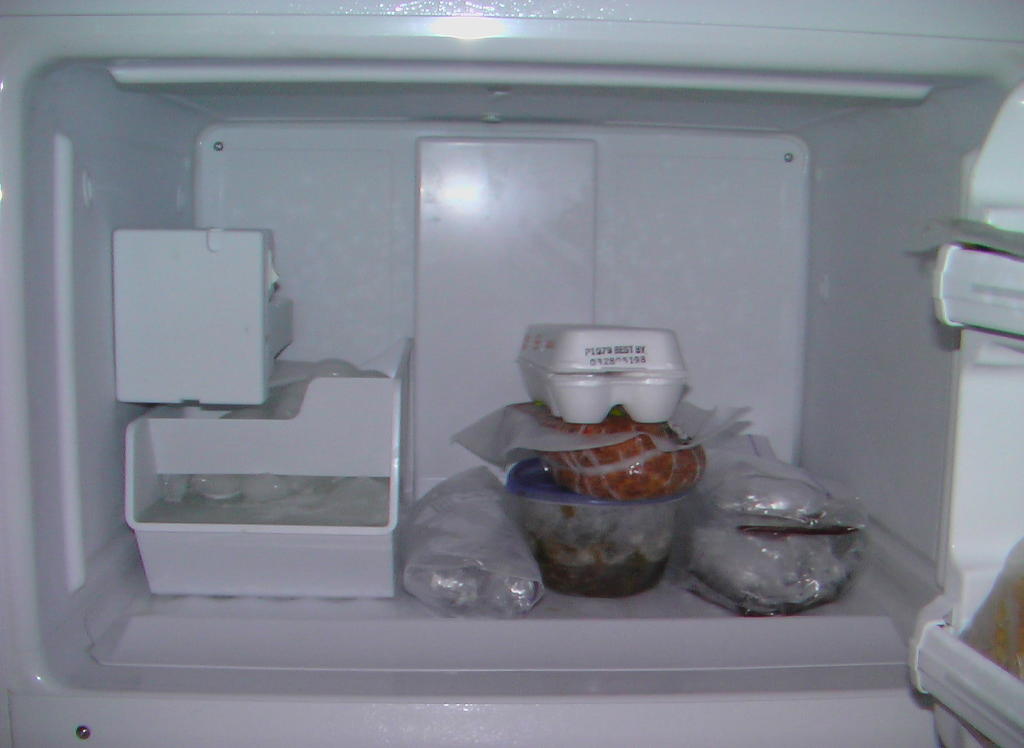
Photo: The negligible disaster refrozen in the top third of my refrigerator. Note the block of melted ice cubes transformed into a frozen block.

9.06.2005

Baton Rouge update

Word is that the city is returning to something like normal. After five days, the power was restored to the corporate apartment where I stay in East Baton Rouge parish. So everthing that thawed will freeze again while I spend this week working at home.

Gas is available but lines are long and prices are high, I hear. Grocery stores are getting deliveries regularly, though many are closing early. I continue to hear rumors of lawlessness, but few or none of these are confirmed. Safe, yes, but the advice we're getting is not to take chances by going out alone before dawn and late at night. One of my colleagues emailed to say she's back to work today after ten days out: family and house intact, six trees down.

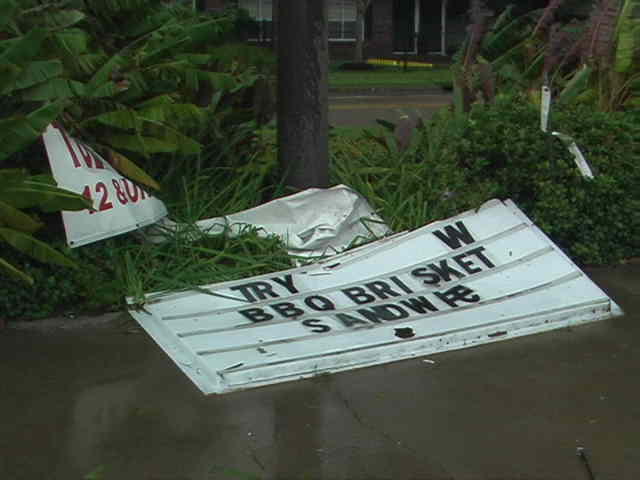
(Photo: Bluebonnet Road, Monday, August 29, 2005)

8.31.2005

Kat no kitty: Hurricane Katrina

Even in this very active storm season, it’s a crap shoot whether a storm will grow enough and throw a threat your way. I’d planned to be in Baton Rouge this past weekend (8/27-28/05), and it was a beautiful one until 6 p.m. on Sunday. The sky lowered gun-metal clouds and the spinning storm raked them into furrows. The rain started. The rain stopped. I came away from the grocery story after an hour and a half wait with water, batteries, charcoal, sausage, beans, and buns believing I would not need them. Hoping I would not have to light the last candles to be had: Moonlight Sighs votives.

I woke up Monday morning to the sound of jetliners low overhead. The power flickered off about 5 a.m. Then flickered on. Then off, and as far as I know, it stayed that way. The dawn brought a yellow-brown sky to light the trees bending in a vacuuming wind from all directions. As a lifelong Yankee, I was afraid. Nor’easters blow. This sucked. Those were no jetliners; that was the storm wind. The question that eats at you the way the pressure stabs your sinuses is, if this is the beginning, how can it end?

For me, it ended in an airport in Houston the following day. Late Monday in BTR I saw some roof shingles flung around, a few signs and fences down, a half-dozen trees tipped over, and all of nature’s leaf bag shaken out by Katrina. I was without power, so you knew more about the storm than I did. Local radio, which I tuned to, relayed questions and spotty answers from people with cell phones standing on their porches. “Clarence, [the host’s real name] I’ve got a sister in Kenner and all I hear is bad news out of there. Can you tell me what’s happening in Kenner, near Thibodeaux Road, and in LaPlace where my MawMaw’s kin live?”

Power was coming back on in West Baton Rouge, someone said, but the utility warned it could be five days or more before the entire city was restored. Without air conditioning, news, refrigerator, internet, or air conditioning (emphasis mine), it seemed a good time to accept my girlfriend’s urging and come home. Thirteen hours of Tuesday later, I was there.

I was always safe but for three hours I was scared I wasn’t. Remind me to tell you about the books I read before the sun went down. There was no moonlight. But there were Moonlight Sighs.

Thanks for all your benevolent thoughts, prayers, fretting, nail-biting, and railing at the storm. Assume the picture above, tells you nothing. In the future, my storm strategy is plan, prepare, then RUN AWAY EARLY.