9.17.2005

Volunteer Training


The Federal Emergency Management Agency (FEMA) set up a Find Family national call center and asked for volunteers to help staff the phones. On Tuesday night I went for a one-hour training session that consisted of how to fill out forms for callers reporting people missing or known to be dead.

We learned not to give moral advice ("You have to be strong for your family.") or religious sentiment ("It's God's will that...."). We learned to try to offer compassion or at least sympathy ("I can't imagine how hard this must be." "I'm here. I'll stay on the line as long as we need to.")

I say we haven't been answering phones. Call volumes are low, and today it appears that calls weren't rolling to available phones down the banquet tables set up in a hotel ballroom near here. But on Thursday night I sat across from a woman who evacuated from Jefferson parish. She's staying with family. Her son's house in the capitol city is full. There are six families sleeping on air mattresses in every room of the house, so she went to a cousin's house instead. She can't find an apartment, her job has disappeared, and she cannot find out whether she can return to collect her stuff.

She'd consider moving, she said, but she'd need a job, which would cost her all of the years of service here, with all it's implications for pension and retirement. She told me she felt fortunate to have gotten food stamps, though she showed up at 4:00 a.m. to get in a line that was already long. The doors opened at 6:00 a.m. and she walked out the exit at 11:30 a.m. And she was pretty cheery as she waited for calls from other evacuees, getting paid a temp's $8.00/hour thanks to FEMA. "At least it's something," she said.

Last night, the local station broadcast a message that many shelters have a full supply of evacuees needs and that cash contributions should be made to the Red Cross instead. Now's the time to start thinking about concrete help beyond keeping body and soul together: jobs, housing, skill training, child care, and the list goes on.

Think hard about where to contribute again. The government is not going to take care of everyone. Given what we've seen lately, it makes sense for communities, businesses, and service agencies to collaborate to help give people new lives with possibilities, not just a trailer and a handout.

(Photo: Another beauty by an unknown photography from, I presume, Sunday, August 28.)

9.15.2005

Twister


Here is the first of a series of photos that were taken by, well, I don't really know. One of the women I'm working with was so excited that I'd stayed through Katrina, she immediately wanted to share these. "I keep telling my kids, this is history." But what about the damage? As Frou Frou sings, "...there's beauty in breakdown...."

9.11.2005

And we're back


Returned to Baton Rouge today through Houston, where I saw or heard:

"Expect to be there six months. That's what they told me." Overheard; a ServiceMaster employee, wearing a brand-proud tee shirt and that read "Disaster Recovery" on the back. These are the people that suck water out of carpet, but tarps over open roofs, and do a thousand things that insurance companies agree to pay for.

"Those four guys in Slidell? We're going to get them out of there. One of them got really bad infection." Overheard; first class passenger on his cell phone.

Seen: A man carrying a deep underwater diving helmet. A woman in a yellow tee shirt and matching yellow and black back pack. Her shirt read "Volunteer Minister," and on each sleeve, "Church of Scientology" and a crest. And on the airport tarmac, about thirty military helicopters, a trailer-office of the Texas National Guard, sixty pallettes of bottled water.

In Baton Rouge, after the high state of worry and outrage that struck us who are not in New Orleans, I expected shock and dismay to have marked the city somehow. It appears unchanged: Lots of billboards for personal injury lawyers, college students in my apartment complex sunning by the pool, pork on sale at the Albertson's.

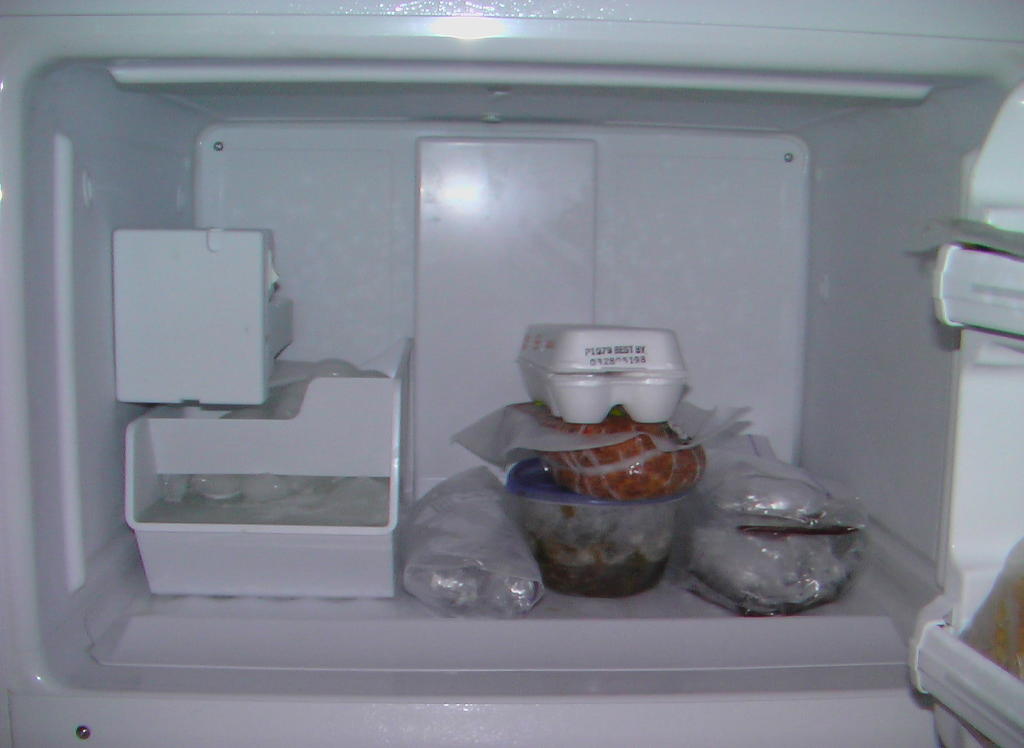
Photo: The negligible disaster refrozen in the top third of my refrigerator. Note the block of melted ice cubes transformed into a frozen block.

9.06.2005

Baton Rouge update

Word is that the city is returning to something like normal. After five days, the power was restored to the corporate apartment where I stay in East Baton Rouge parish. So everthing that thawed will freeze again while I spend this week working at home.

Gas is available but lines are long and prices are high, I hear. Grocery stores are getting deliveries regularly, though many are closing early. I continue to hear rumors of lawlessness, but few or none of these are confirmed. Safe, yes, but the advice we're getting is not to take chances by going out alone before dawn and late at night. One of my colleagues emailed to say she's back to work today after ten days out: family and house intact, six trees down.

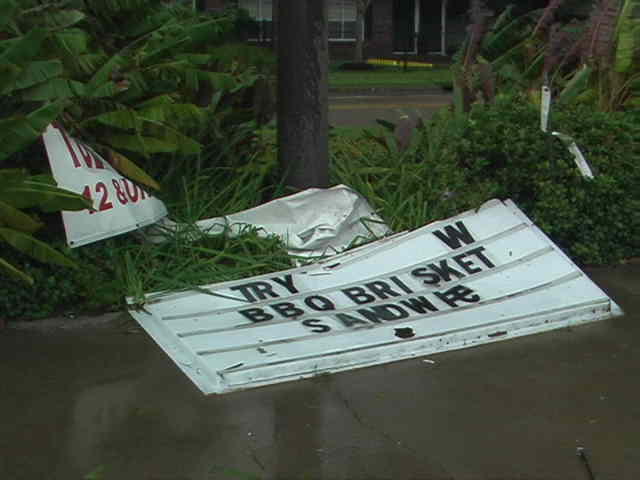
(Photo: Bluebonnet Road, Monday, August 29, 2005)

8.31.2005

Kat no kitty: Hurricane Katrina

Even in this very active storm season, it’s a crap shoot whether a storm will grow enough and throw a threat your way. I’d planned to be in Baton Rouge this past weekend (8/27-28/05), and it was a beautiful one until 6 p.m. on Sunday. The sky lowered gun-metal clouds and the spinning storm raked them into furrows. The rain started. The rain stopped. I came away from the grocery story after an hour and a half wait with water, batteries, charcoal, sausage, beans, and buns believing I would not need them. Hoping I would not have to light the last candles to be had: Moonlight Sighs votives.

I woke up Monday morning to the sound of jetliners low overhead. The power flickered off about 5 a.m. Then flickered on. Then off, and as far as I know, it stayed that way. The dawn brought a yellow-brown sky to light the trees bending in a vacuuming wind from all directions. As a lifelong Yankee, I was afraid. Nor’easters blow. This sucked. Those were no jetliners; that was the storm wind. The question that eats at you the way the pressure stabs your sinuses is, if this is the beginning, how can it end?

For me, it ended in an airport in Houston the following day. Late Monday in BTR I saw some roof shingles flung around, a few signs and fences down, a half-dozen trees tipped over, and all of nature’s leaf bag shaken out by Katrina. I was without power, so you knew more about the storm than I did. Local radio, which I tuned to, relayed questions and spotty answers from people with cell phones standing on their porches. “Clarence, [the host’s real name] I’ve got a sister in Kenner and all I hear is bad news out of there. Can you tell me what’s happening in Kenner, near Thibodeaux Road, and in LaPlace where my MawMaw’s kin live?”

Power was coming back on in West Baton Rouge, someone said, but the utility warned it could be five days or more before the entire city was restored. Without air conditioning, news, refrigerator, internet, or air conditioning (emphasis mine), it seemed a good time to accept my girlfriend’s urging and come home. Thirteen hours of Tuesday later, I was there.

I was always safe but for three hours I was scared I wasn’t. Remind me to tell you about the books I read before the sun went down. There was no moonlight. But there were Moonlight Sighs.

Thanks for all your benevolent thoughts, prayers, fretting, nail-biting, and railing at the storm. Assume the picture above, tells you nothing. In the future, my storm strategy is plan, prepare, then RUN AWAY EARLY.